Guide · Bidding remodeling jobs
How to bid construction jobs as a remodeler: a bathroom bid, line by line
Bidding a remodeling job is two jobs at once: pricing the work so it pays, and writing the bid so the homeowner signs it. Here's how to bid construction jobs both ways, using a real master bathroom bid, from the question to ask before you measure to the follow‑up after you send it.
By Ali Kashif, who runs Booked Remodelers · Built from a working remodeler's own bid · 26 October 2026 · About 11 minutes
How to bid construction jobs that get signed
A bid that gets signed answers five things a number alone doesn't: why the homeowner wants the work, what's in the price and what isn't, what happens when you open a wall, what their options are, and when they'll hear from you next. Miss one and the price is all they have left to compare.
Most guides to bidding construction jobs are written for commercial work: bid boards, plan rooms, takeoffs from drawings. A bathroom for a family that lives in the house is a different sale. The family decides whether to trust you with their home, and they're usually weighing you against someone else.
In Modernize's homeowner research, 42% of homeowners compared two quotes, 28% compared three and 16% compared four or more. Your bid has to win that comparison, and a bid with nothing in it but a number loses it to a smaller number.
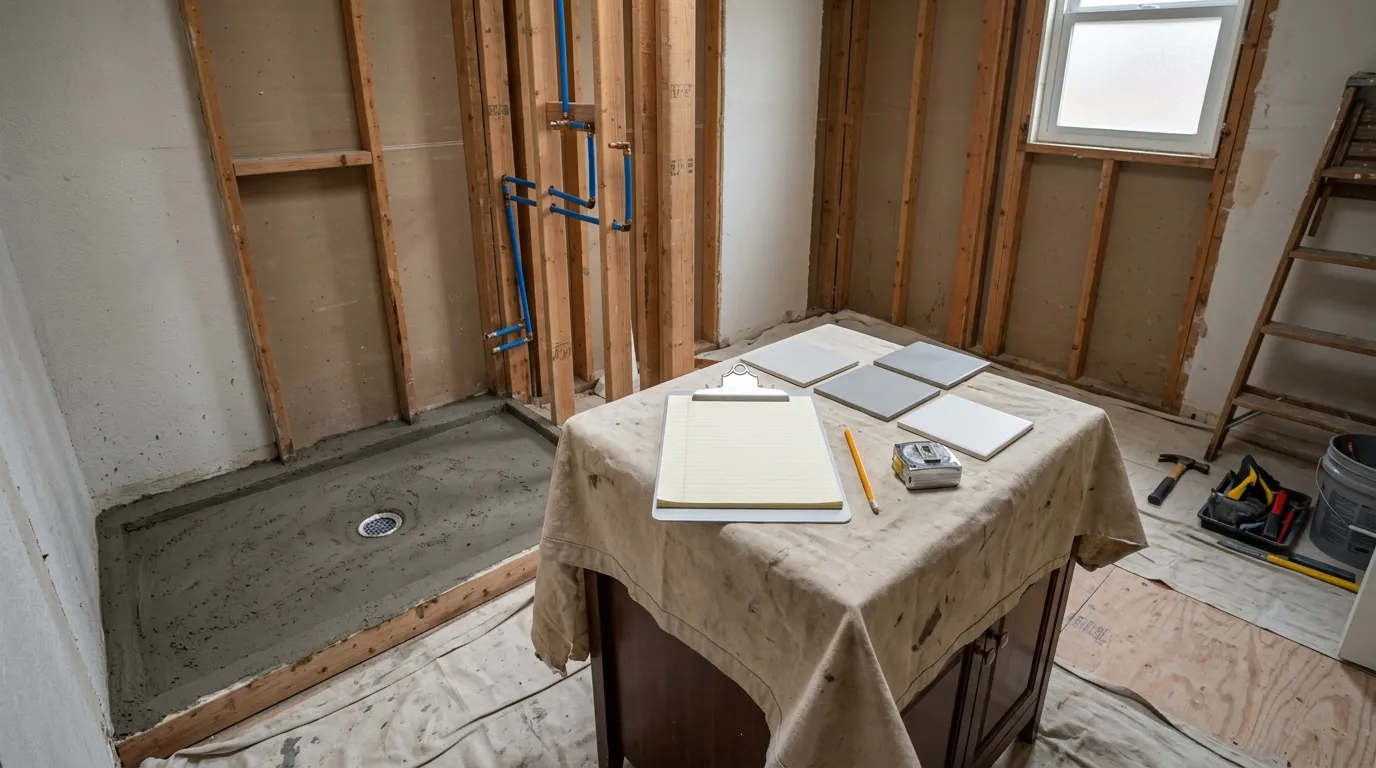
Before you measure, ask why they want it done
Ask one question before the tape measure comes out: "What's your biggest reason for wanting to do this?" The answer tells you what to bid, how to explain it and what your follow‑up should say. Without it, your bid is a list of fixes and a number.
A good craftsman walks into a bathroom and sees what's wrong: the cracked grout, the old toilet, the tub nobody uses. So the bid becomes a list of fixes and a price. That's when you hear "Is that the best you can do?", and then the homeowner goes quiet.
Two common answers show how the reason changes the bid.
- "My mom is moving in" or "We fight over the space." Now you're bidding the end of the argument: four drawers for one of them, two for the other, and the tub nobody uses swapped for a walk‑in shower that's easy to get in and out of.
- "We're selling in a year or two." Now you bid to a standard every buyer will like, and you say so. Your job is to spend their money only where a buyer will notice it.
Write the answer down in their words. It goes at the top of the bid, and it goes into every check‑in after you send it.
Ask about money before you drive out, too. A budget question on your form, or a range said out loud on the first call, tells you whether the visit is worth the drive. For the bathroom below, that's something like "projects like this usually land between $10,000 and $12,000. Does that fit what you had in mind?"
Price it line by line: a real master bathroom bid
The Handyman Business is a YouTube channel run by a working remodeler, and in one video he prices a five‑piece master bathroom out loud, line by line: How To Estimate A Bathroom Remodel. It's about six years old, so his numbers are low for most markets today. The method is the useful part, in a spreadsheet or in software, and our post on remodeling estimating software covers that choice.
He prices labor and rough materials only. The homeowner buys the finishes: the tile, the fixtures, the tub and the glass. Everything under the tile is his, waterproofing included, and his overhead and profit are rolled into every line.
| Line | His price | What's in it | What the homeowner buys |
|---|---|---|---|
| Shower, full gut and rebuild | $3,000 | Demo and disposal, the mortar‑bed pan with its curb, slope and drain, the walls, backer board, thinset and all the waterproofing | Tile, grout, the valve trim kit, the frameless glass |
| Jetted garden tub out, clawfoot tub in | $1,800 | Demo, prepping and tiling the walls, hooking up the drain | The clawfoot tub and its faucet |
| Vanity top, sinks and faucets out and back | $800 | Demo of the tiled top, new shutoff valves, setting and hooking up the sinks and faucets | The solid‑surface top (a specialty trade), the faucets |
| Floor, about 60 square feet | $1,800 | Old tile, baseboard, three doors and the toilet out, subfloor prep, everything under the tile, laying it | The tile |
| Mirror | $500 | Taking down a big glued‑on mirror, the drywall repairs, hanging and centering two new mirrors | The mirrors |
| Four light fixtures | $500 | Installing them (about $150 each, rounded down) | The fixtures |
| Two custom side cabinets | $1,400 | Built in his shop, painted, delivered and installed with hardware | Nothing, turnkey |
| Paint | $500 | Painting the bathroom | Nothing |
| Unknowns | $1,000 | "Anything that I didn't think of" | Nothing |
The lines as he reads them in the video add up to $11,300. On camera he gives the total as $10,900.
In short: $10,900 for his lines, $11,900 with the conditions line below, and $13,000 to $15,000 for a five‑piece master in his market once the homeowner's finishes are in.
His total matched the number he had in his head before he walked in, and he says a master bath lands in that last range "every single time". That's experience pricing, and it works because he's done dozens.
Labor and rough materials, or a turnkey price?
His price leaves out the tile, the clawfoot tub, the faucets, the mirrors, the light fixtures and the frameless shower door, which he tells the homeowner to expect to pay about $1,800 for. A homeowner holding that bid next to a turnkey price of $25,000 isn't comparing the same bathroom.
Either number can be right, as long as the bid says what's in it. Put a plain "Not included" list on every bid, or the bid that only looks cheaper wins a comparison it shouldn't.
Check your split against a published one
My Boys Contracting, a family remodeler in Nassau County on Long Island, published a bathroom cost breakdown in February 2025. A basic remodel at $10,000 to $20,000 keeps the layout and updates the fixtures, flooring and paint. Mid‑range, the most common, runs $25,000 to $40,000, with upgraded finishes, a new vanity, a tiled shower and some plumbing changes. High end runs $50,000 to $80,000 or more.
- Labor and permits30 to 40%
Plumbing and electrical $3,000 to $8,000, tile installation $5,000 to $12,000, permits and inspections $500 to $2,000.
- Fixtures and features25 to 35%
Toilet $300 to $1,500, vanity and sink $1,500 to $8,000 or more, tub $1,500 to $10,000, shower system $2,000 to $15,000.
- Tile and flooring15 to 25%
Porcelain or ceramic $5 to $15 a square foot, natural stone $10 to $30 or more, heated floors $2,000 to $5,000.
- Extras and upgrades10 to 20%
Smart mirrors and lighting $500 to $2,500, custom storage $1,500 to $5,000, a rain shower or body jets $2,500 to $10,000.
Share of the total budget by category, with typical line costs. My Boys Contracting, Nassau County, New York, February 2025. One company in one market, so treat it as a rough check.
Use it as a sanity check. If your labor share sits far outside theirs, find out why before you send the bid. Moving plumbing is the line that moves most, and their first tip for saving money is to keep the layout.
Price for your own market
The national midrange bathroom remodel averaged $26,138 in Cost vs Value 2025. The comments under his video run from his $11,900 to "$40k without finish materials". A homeowner in Illinois wrote that contractors there charge "at least $35k for the same project".
Your next bid should come from your own numbers: what your last ten bathrooms cost you to build, and what you charged for them. Our free estimate template keeps them for you: bid from your own unit costs, log what each line really cost, and the next bid is tighter.
How much contingency should a remodeler carry?
On a bathroom where you'll open walls and floors, carry an unknowns line of about 10%. He put $1,000 on roughly $10,000 of work "to cover anything that I didn't think of." Write on the bid what it covers and what happens to any of it you don't use.
The American Institute of Architects calls it a contingency allowance: money set aside in the contract for changes nobody can see coming. In a bathroom those changes live under the tile: a rotted subfloor around the toilet, an old drain line, walls that aren't plumb.
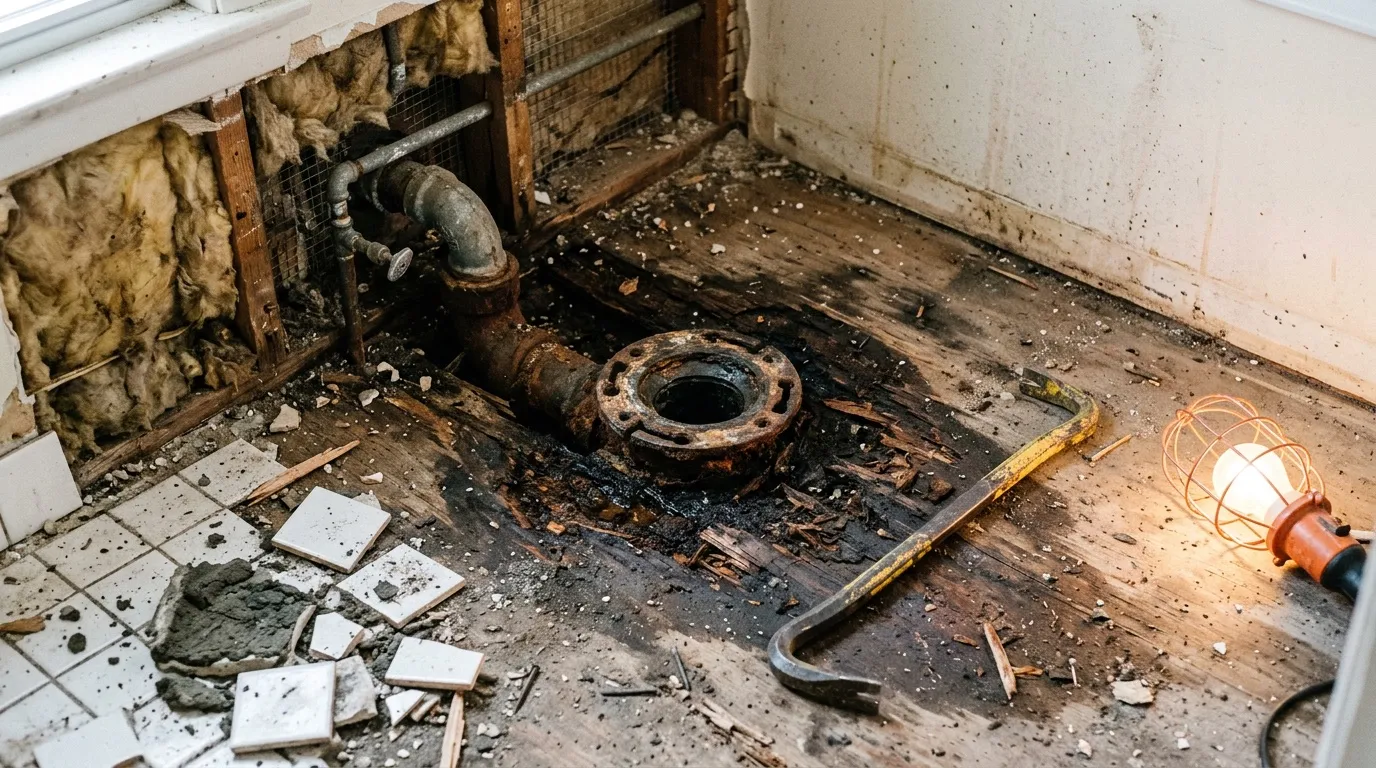
Contractors in his comments learned it the hard way. One in the UK said he's doubling his unknowns line from £250 to £500. Another adds one to every job, "and every time i thank God i did because i would have had to eat $500‑1000."
If you'd rather keep it out of the price, use an allowance and a written change order for anything you find. Either way, put it on paper before the first tile comes up.
Price the conditions, not the person
After the line items he added one more $1,000. The homeowner keeps her house spotless, with both tables set as if guests were coming, and he knows that job will take extra care: "With that information we're gonna throw on another thousand dollars."
His comments split. One estimator with 30 years behind him called it a good idea. Another viewer said he wouldn't hire him to build a dog house. The useful answer came from a contractor who did the math: an extra hour a day of setup and cleanup for a two‑person crew is worth at least $100 a day, and over two weeks that's the $1,000.
So price the time, and write it as work: "Daily floor protection, dust control and a full cleanup in a lived‑in home." A homeowner reads that line as care. A line that prices their personality reads as an insult.
Make sure overhead and profit are in the number
He says his profit, his overhead, "everything is rolled into" each line. That works when your experience numbers already carry them. Check that yours do.
In NAHB's latest Remodelers' Cost of Doing Business study (2024 data, published April 2026), remodelers averaged a 29.9% gross margin and a 6.3% net profit. The gap between the two, roughly 24 cents of every dollar, is about what it costs the average remodeler to run the company.
Keeping a 29.9% margin takes a markup of about 43% on your job costs. The "10% overhead and 10% profit" rule you'll hear is a 21% markup, about a 17% margin, which wouldn't cover the average remodeler's overhead.
| $10,000 of job cost | Price | Left for overhead and profit |
|---|---|---|
| 43% markup (a 30% margin) | $14,300 | $4,300 |
| "Ten and ten" (about a 17% margin) | $12,100 | $2,100 |
Example. $10,000 × 1.43 = $14,300. $10,000 × 1.10 × 1.10 = $12,100.
The full math is in our contractor markup guide, and the calculator shows what one more signed bathroom is worth at your own margin.
Send three options, not a line‑item breakdown
Give the homeowner two or three complete options with one price each, and keep the line items for yourself. Options let them change the scope when the number is high. A breakdown invites them to haggle it line by line.
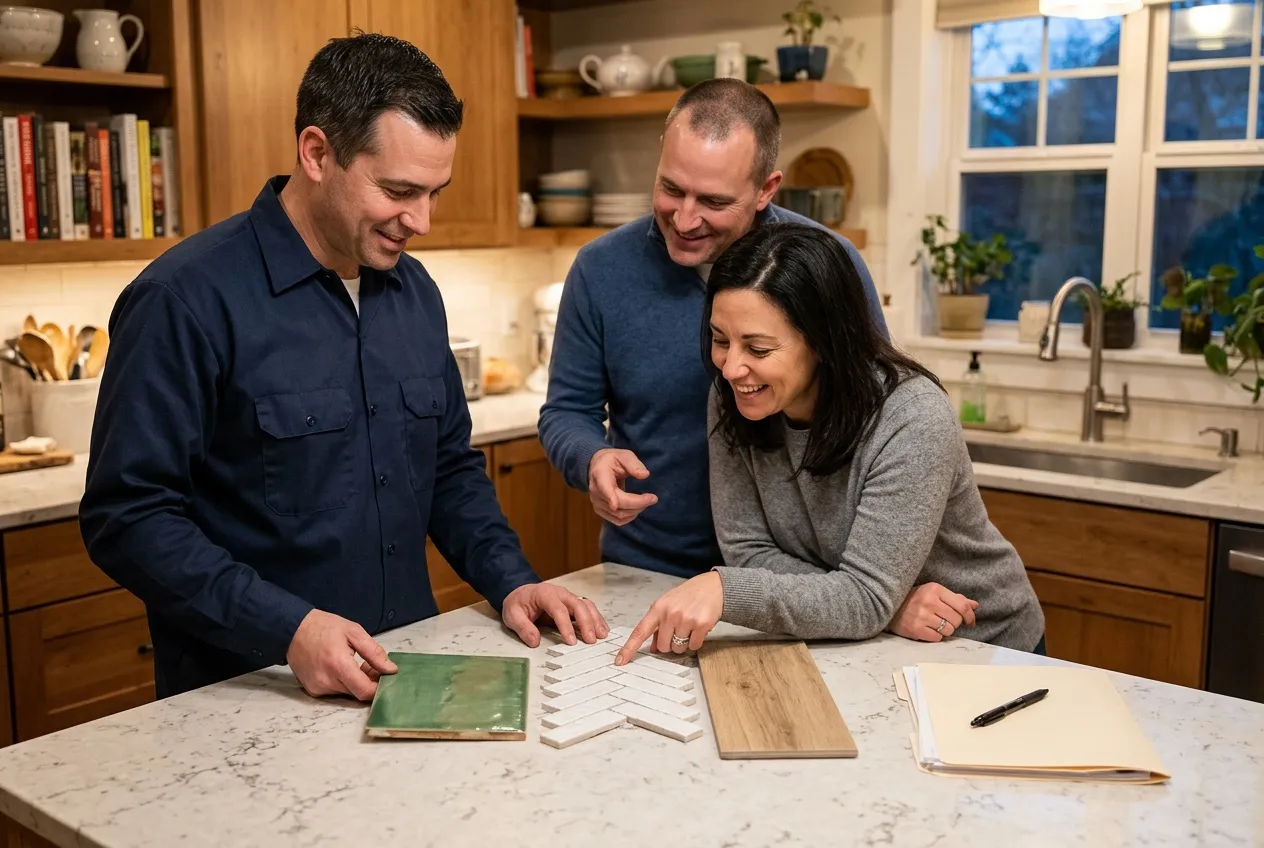
On camera he asks himself whether to break all this out, and decides he won't. The homeowner gets three numbers, built around the options she asked about: niches in the shower, the clawfoot tub in place of the garden tub, and the custom side cabinets. "She's not gonna get anything broke out."
A remodeler in the comments explained why. If you aren't practiced at defending a breakdown, homeowners "WILL push you down to the number they want with out reducing the work involved." Options fix that: when the full scope is too much, they pick a smaller one, and your price stays honest.
Price is the usual sticking point. In Housecall Pro's 2026 survey of more than 1,100 homeowners, 68% got other quotes when a price came in higher than they expected, and 62% were more likely to go ahead when financing was offered. If you offer financing, put it on the bid.
After you send it, follow up until you get a yes or a no
A quiet bid usually means a homeowner who's busy, unsure or still comparing. Check in on day 2, day 5, day 10 and day 21, short and in your own words, and stop the moment they answer. The check‑ins that work bring back the reason they gave you at the walkthrough.
Here's that schedule for one bathroom, with the homeowner's reason doing the work.
| When | The text, from the owner's phone |
|---|---|
| Day 2 | Hi Sarah, it's Mike at Larkmoor Remodeling. Just making sure the bathroom estimate came through. Any questions I can answer? |
| Day 5 | Hi Sarah, you said your mom moves in this spring. If we start by early March, the new bathroom is done before she arrives. Want me to hold that spot? |
| Day 10 | Hi Sarah, if the full scope came in higher than you hoped, option two keeps the walk‑in shower and the drawers and drops the side cabinets. Want me to walk you through it? |
| Day 21 | Hi Sarah, I don't want to keep bothering you. Should I keep the bathroom estimate open, close it out, or check back in a few months? |
Example. Larkmoor Remodeling, Mike and Sarah are made up.
Agree on the check‑ins before you leave the walkthrough: "Is it OK if I text you a few times over the next three weeks? Just reply yes, no or not yet." A homeowner who said yes reads each text as you keeping your word.
| Day | Without us | With Booked |
|---|---|---|
| Day 0 | Estimate sent | A thank‑you, same day |
| Day 2 | Nothing | A quick check‑in |
| Day 10 | Still nothing | The honest question |
| Day 21 | Went to someone else | A yes or a no |
| Day 30 | Already gone | A review request |
| Result | Lost on day 21 | Signed |
Same estimate, same homeowner. The difference is who kept talking. Every step of the follow‑up
That's the follow‑up Booked runs for remodelers: estimate follow‑up on day 2, 5, 10 and 21, written with you, sent from your number, stopping on any reply. Estimates that already went quiet get their own reactivation campaign.
What did your last estimates get back from you? In the free 30‑minute follow‑up audit we work out what your quiet estimates are worth from your own numbers, and show you the follow‑up we'd run, message by message.
Book my free follow‑up auditSix bidding mistakes that cost remodelers jobs
Each one is fixed somewhere above. If your last three bids went quiet, start with the ones you recognize.
- Pricing the job before you know why they want it done. The fix: Ask why before you measure
- A labor‑only price with no list of what it leaves out. The fix: A real bathroom bid, line by line
- No line for what sits behind the walls. The fix: How much contingency to carry
- Overhead and profit left to whatever is left over. The fix: Overhead and profit in the number
- Sending the full line‑item breakdown. The fix: Three options, not a breakdown
- Sending the bid, then waiting for the phone to ring. The fix: Follow up until yes or no
Booked · the follow‑up system
One signed bathroom job pays for about two years of Booked
A good bid still goes quiet if nobody follows it up. Booked follows up each estimate for you on day 2, 5, 10 and 21, in your words, and texts back every missed call in under a minute.
Booked
$297 a month
Start today: $774, then $297 a month month to month
$774 is your first month plus the one‑time $477 setup. Stop any month with 30 days' notice.
- Estimate follow‑up until you hear yes or no
- Old leads and past customers brought back
- A review request after every job, with follow‑ups
- Instant reply to every new inquiry, and a booking link
- Missed‑call text‑back and call connect
- Estimate visit confirmations and reminders
- One inbox and the mobile app
- Bonus 2 months of social posts, written and scheduled
The math: a midrange bathroom remodel costs $26,138 nationally (Cost vs Value 2025), and remodelers keep 29.9% of the price as gross profit on average (NAHB, 2026). That's about $7,800 from one job.
How do you weed out the time wasters and find clients who will pay what the work is worth?
Mostly before you drive out. Publish price ranges for your main jobs, so a homeowner with a much smaller budget rules themselves out. Ask about budget and timing on the first call. Then follow up every bid you send, so the serious homeowners don't slip away while you chase the rest.
Should I give the homeowner a line‑item breakdown?
Usually not. Give two or three complete options with one price each, and a plain list of what's included and what isn't. A breakdown invites the homeowner to haggle each line. Options let them change the scope instead of asking you to cut the price.
How much contingency should I add to a remodeling bid?
The bathroom bid in this guide carries $1,000 on about $10,000 of work, roughly 10%, with the walls and floor coming out. Carry more on an old house. Write on the bid what the line covers and what happens to any of it you don't use, or use an allowance with written change orders instead.
Is waterproofing part of the shower price?
It should be. In The Handyman Business's bid it sits inside the $3,000 shower line with the mortar bed, curb, drain and backer board. What a labor‑and‑rough‑materials bid leaves out are the finishes the homeowner picks: tile, grout, the valve trim and the glass.
How soon should I follow up after sending a bid?
Two days after you send it, then on day 5, day 10 and day 21, and stop the moment they answer. Keep each message short, from you, and about their project. Bring back the reason they gave you at the walkthrough instead of a plain "just checking in".

Free follow‑up audit
Find out what your quiet estimates are worth.
Thirty minutes on a call. We work it out from your own numbers, then show you the follow‑up we'd run for your business, message by message.
4.8 out of 5 from 3,668 reviews14,300+ orders completed on Fiverr9 years in local SEO
You walk away with
- What your quiet estimates are worth, from your own numbers
- The follow‑up we'd run for you, message by message
- The messages by email after the call, yours to keep
- A straight answer on whether Booked fits
Free. 30 minutes. If Booked isn't a fit, we'll say so.